
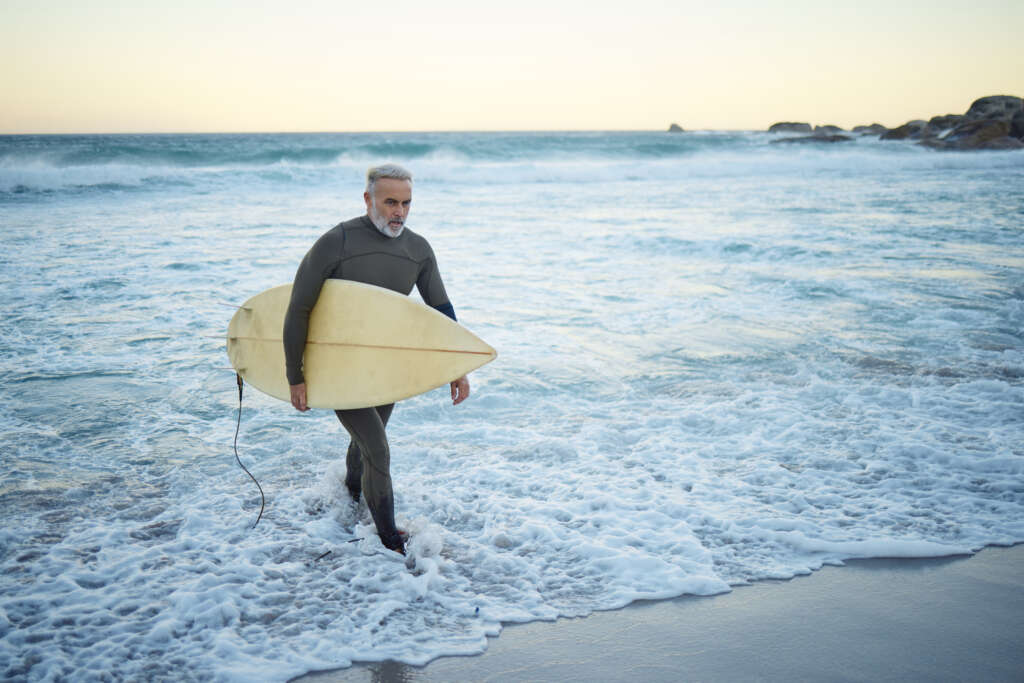
Chasing the Green Wave: A Midlife Adventure Worth Adding to Your Bucket List
At 50, you’ve probably checked off plenty of life’s major milestones. Career established,
mortgage payments a familiar routine. But here’s something that might not be on your radar yet: catching a green wave. Not the financial kind or some environmental metaphor, I’m talking
about standing up on a surfboard and catching an unbroken wave.
Why This Should Matter to You at 40, 50 or 60yrs old
You might be thinking, “Isn’t surfing for twenty-something nonchalant vibey dudes?” The simple
answer is No, if you take the time to get down to a surf beach, you’ll find plenty of older people.
So, here’s why catching a green wave deserves a spot on your bucket list:
It’s the ultimate present-moment experience. In our hyperconnected world, finding genuine
presence is rare. When trying to catch a green wave, there’s no room for work stress, financial
worries, or family drama. There’s only you, the water, and physics in perfect harmony.
The learning curve is part of the reward. Unlike many bucket list items you can buy your way
into, or tick off after a few weeks or months; earning your first green wave takes serious time,
not to mention dedication, practice, and respect for the ocean. Although admittedly, you will
have to invest in a few holidays by the beach (which is also why this is a great bucket list item)
It’s also surprisingly achievable. You don’t need to paddle out in Hawaii or some far-flung
place. There are lots of opportunities to surf all around the world, wherever you’re based. And
with proper instruction and patience, most reasonably fit adults can work toward this goal and
achieve something reasonably proud-worthy after 2-3 surf holidays.
Getting Started: A Realistic Roadmap
Step 1: Learn the Fundamentals Before thinking about green waves, you need solid surfing
basics. Consider a week-long surf camp somewhere that’s not more than 1-2hr flight away. In
Europe, great options exist in France, Spain, Portugal or a bit further away in Morroco. At
50, your body might need more time to adapt than a teenager’s, but your mental game –
patience, wave reading, understanding risk – can actually be superior.
Step 2: Choose Your Destination Wisely Some spots are better for learning. Here are
beginner-friendly destinations by region:
Europe:
- Ericeira, Portugal – Consistent waves, excellent surf schools, multiple beginner breaks
- Biarritz, France – Gentle beach breaks perfect for learning, established surf instruction
- Fuerteventura, Canary Islands – Year-round waves, warm water, protected bays for
beginners
Asia:
- Bali, Indonesia (Kuta Beach) – Soft sand bottom, forgiving waves, world-class
instruction - Weligama Bay, Sri Lanka – Protected bay with gentle waves, stilt fishermen backdrop
Africa:
- Taghazout, Morocco – Beginner-friendly point breaks, affordable surf camps,
consistent swells - Muizenberg, South Africa – Famous beginner beach with colored beach huts, shark
spotters
North America:
- Sayulita, Mexico – Gentle beach break, warm water, vibrant Mexican surf town
- Cocoa Beach, Florida – Consistent small waves, warm water year-round, surf schools
South America:
- Florianópolis, Brazil – Joaquina Beach offers gentle waves, warm water, party
atmosphere - Máncora, Peru – Consistent small waves, year-round surfing, backpacker-friendly
- Montañita, Ecuador – Forgiving beach break, budget-friendly, lively surf community
Australasia:
- Byron Bay, Australia – Multiple beginner breaks, excellent surf schools, bohemian vibe
- Raglan, New Zealand – Sheltered bays for learning, black sand beaches, laid-back
town - Noosa, Australia – Protected points perfect for beginners, upscale resort town
Step 3: Invest in Your Body At 50, preparation matters more than ever. Start a surf-specific
fitness routine months before your trip. Focus on paddling strength, core stability, and flexibility.
Yoga becomes your friend. Consider working with a trainer who understands surfing’s physical
demands.
Step 4: Manage Expectations and Embrace the Process The first time you stand up on a
surf board, might be a quick, one-two-second affair where you barely know what’s happened
before you crash back into the surf. That’s not failure – that’s success. The progression from
that first taste to consistently catching waves can take many practice sessions, and that’s
exactly the point.
The Reality Check
Let’s be honest about what you’re signing up for. Learning to surf at 50 means accepting that
your body recovers slower, your reflexes might not be as sharp, and you’ll probably spend more
time underwater than you’d prefer initially. You’ll get worked over by waves, drink more
seawater than seems reasonable, and question your sanity more than once.
But here’s what else happens: you’ll discover muscles you forgot you had, develop an intimate
relationship with weather patterns and tides, and find yourself checking surf forecasts
obsessively. You’ll experience the ocean’s power in ways that change how you see the natural
world.
Beyond the Horizon
Even if you never catch that perfect green wave, the pursuit itself transforms you. You’ll join a
global community of wave riders who understand that the ocean doesn’t care about your job
title, bank account, or social status.
The friends you’ll make, the places you’ll travel, and the perspective you’ll gain make every hour
of practice worthwhile. And when you finally do get that first wave – you’ll understand why
surfers become addicted to the sensation.
Making It Happen
If this resonates with you, start planning now. Research surf schools that cater to adult
beginners. Book that trip to a surf destination you’ve always wondered about. Begin the fitness
routine that will prepare your body for ocean athletics.
Most importantly, approach this adventure with the same methodical planning you’ve applied to other life goals, but with the playful spirit you might have forgotten you possess. The ocean has a way of reminding us that we’re never too old to learn something completely new, to challenge ourselves in ways we didn’t think possible, and to find joy in the simple act of riding a wave.
At 50, you have the wisdom to appreciate the journey, the resources to do it right, and hopefully the time to dedicate to the process. The green wave is waiting – the only question is whether you’re ready to chase it.
The best time to plant a tree was 20 years ago. The second best time is now. The same could
be said for learning to surf.